NPS with Febaso
Measure your NPS.
And hear why.
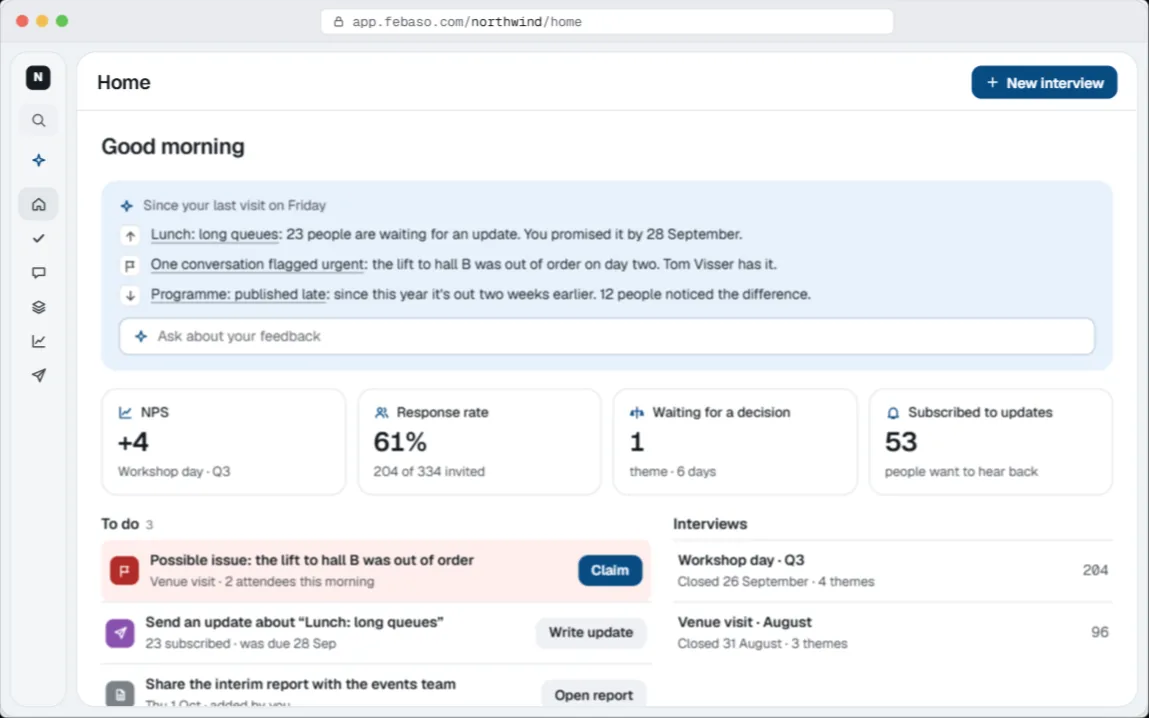
After the score, Febaso asks a follow-up. You see the score and the reasons behind it.
- Asks about every score
- Groups the reasons into themes
- Tells customers what you did
In short
What is NPS?
The Net Promoter Score measures how likely someone is to recommend you, on a scale from 0 to 10. A 9 or 10 is a promoter, a 7 or 8 is passive, and 0 to 6 is a detractor.
How to calculate it
% promotersminus% detractors=Your NPS, from −100 to +100
- The number doesn't say why
- A 6 can be about the price, about support, or about something nobody saw coming. That's why Febaso asks for the reason after the score, and a follow-up when it stays vague.
- Compare with yourself
- What counts as a good score differs per industry and per country. The movement from round to round says more than one number.
NPS was created by Fred Reichheld in 2003. Net Promoter, NPS and Net Promoter Score are registered trademarks of Bain & Company, Inc., NICE Systems, Inc. and Fred Reichheld.
Calculator
Calculate your NPS.
Fill in how many people fell into each group.
Your NPS
+25
45% promoters minus 20% detractors. More promoters than detractors.
What the number doesn't tell you: why. Febaso finds out, in the conversation after the score.
How it works
From one score to the reason.
01
The questions are ready
The NPS question, followed straight away by the question about the reason, with a follow-up when the answer stays vague.
02
Customers answer in a conversation
On their phone or computer, in their own language. First the score, then the why.
03
You decide, they hear it
Febaso lays out the reasons. You choose what to do, and whoever raised it gets a message.
Try it yourself
An NPS survey, from start to finish.
Make an interview, take it as a customer and see what happens to your answer. Two minutes, with made-up data.
Try it yourself: make an interview, take it as a customer and see what happens to your answer. Two minutes.
Sound familiar?
A score that moves, and nobody knows why.
NPS
+12
+8 since 2025
Sessions: too many overlap186Lunch: long queues142Networking: too little time97Today: The NPS in a dashboard, the comments in an export.
With Febaso: The score and the reasons in one place, per theme.
You're chatting with an AI interviewer.
It was good. Mostly.
When wasn't it?
When two sessions I wanted ran at the same time. I had to choose.
Today: The open field stays empty, or says "fine".
With Febaso: A follow-up until you know what someone means.
- Themes513 answers · themes readySessions: too many overlap186Lunch: long queues142Networking: too little time97
Today: Hundreds of comments, nobody reading them.
With Febaso: Every answer read, with counts and quotes.
- From: Northwind
Sessions: the two busiest tracks run apart
At next year's Summit the two busiest tracks run apart, and the programme is out two weeks earlier. We'll tell you how it goes by mid-January.
Today: Customers never hear what you did with their score.
With Febaso: One message per theme to those who raised it.
Sessions: too many overlap
Round 1186Round 2123Round 371Smaller after the update
Today: After an improvement, you don't know if it worked.
With Febaso: The next round shows whether the theme got smaller.
Northwind, Marieke and every answer here are made up for this demo.
Privacy and trust
Read how we handle privacyProcessing in the EU
And never used to train AI models.
Anonymous when you choose
You choose per interview whether answers are anonymous. Anonymous means you never see who said what.
Open about the AI
Customers know from the first message that they are talking to an AI.
Traceable
Every theme shows the count and the verbatim quotes.
Questions about NPS
What is a good NPS?
Anything above 0 means more promoters than detractors. Beyond that, what counts as good differs a lot per industry and per country, so compare mainly with your own previous rounds. A score that rises, with reasons you know, says more than one high number.
How often should you measure NPS?
Whenever something can change: every quarter, or after a moment that matters, such as the first months as a customer. Ask the same question every round, and you see per theme whether it grows or shrinks.
What is the difference between NPS and eNPS?
eNPS asks employees the same question: how likely are you to recommend this organisation as an employer? The groups and the calculation are the same.
Why a conversation and not a regular form?
A form records the score and an open field that often stays empty. In a conversation, Febaso asks for the reason, and a follow-up when it stays vague, up to three times per question. So you know what's behind a 6.
Can I add my own questions?
Yes. The NPS question and the question about the reason are ready. You add your own questions and topics, or let Febaso write them based on what you want to know.
Can I have NPS answers analysed that I already have?
Yes, with the Feedback Analyser: you hand over the open answers and get the themes back. Choose Analyse feedback as the reason in the form.
What does it cost?
Setting up your first interview is free. After that it depends on the size of the round and the number of languages: email us roughly how many people you want to reach, and you'll hear back within one working day.
Measure your NPS, and hear why.
Set up your first NPS interview yourself, for free. Rather talk first? Book an intro: thirty minutes about your situation, with a live demo.
- Asks about every score
- Groups the reasons into themes
- Tells customers what you did
Book an intro
Pick a momentRather write? Send us a message.