Course evaluation with Febaso
Evaluate a course.
And improve it in the same term.
A short conversation with students instead of a long questionnaire. You see straight away what's going on, in their words.
- A grade, and the reason behind it
- Themes while the term runs
- Students hear what changes
In short
What is a course evaluation?
A course evaluation asks students how a course, module or class went: the content, the assessment, the guidance. The results help teachers and the programme adjust their teaching, and are part of quality assurance.
- On time, not afterwards
- An evaluation after the exam only helps the next cohort. A short conversation halfway through the term still lets you adjust for these students.
- Close the loop
- Students take an evaluation more seriously when they see what happened after the last one. Febaso sends one message per theme to those who raised it.
How it works
From a grade to a better course.
01
The questions are ready
A grade for the course, the reason behind it, and topics such as assessment and feedback. Febaso asks follow-ups where the why matters.
02
Students answer in a conversation
On their phone, after class or at home, in their own language. Through a link or the QR code on the last slide.
03
You adjust, they hear it
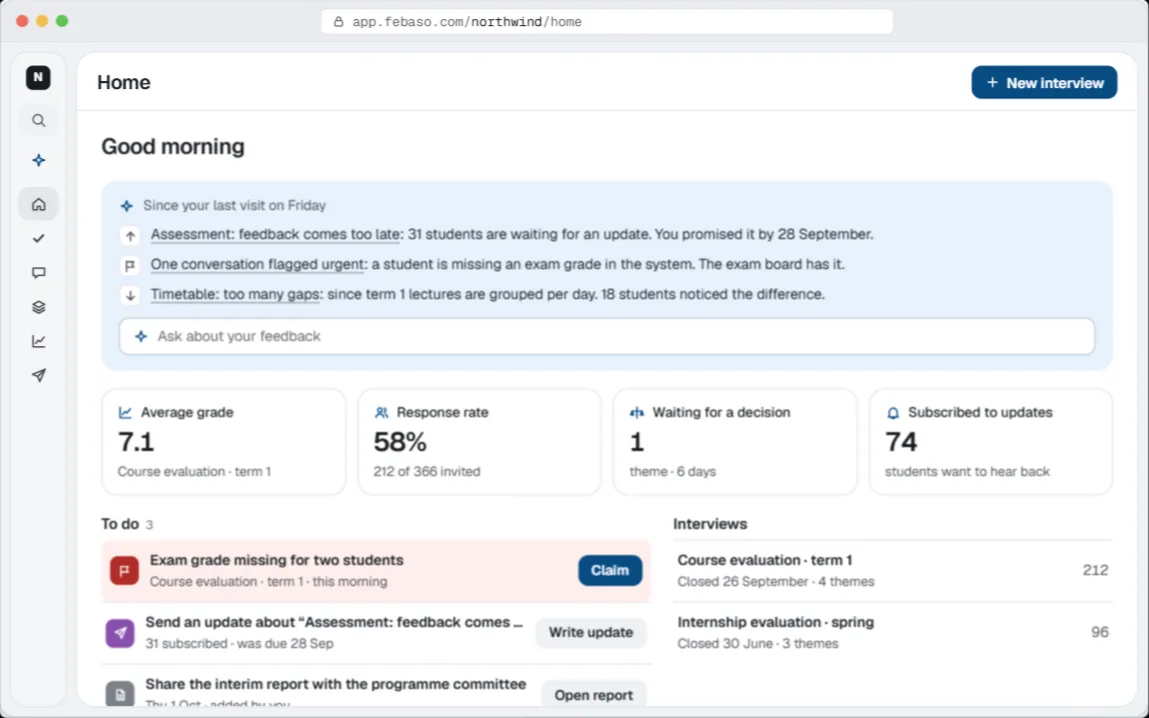
Febaso lays out the themes. You choose what to change, and whoever raised it gets a message.
Try it yourself
A course evaluation, from start to finish.
Make an interview, take it as a student and see what happens to your answer. Two minutes, with made-up data.
Try it yourself: make an interview, take it as a student and see what happens to your answer. Two minutes.
Sound familiar?
Evaluations that only say something after the term.
Programme team, Northwind College
How was Research skills?
About 4 minutes · the programme won't know who said what
Thank you for telling us how the course Research skills went. Your answers help us decide what to keep and what to change in term 3.
What grade do you give the course Research skills?
12345678910Today: A questionnaire after the exam that hardly anyone fills in.
With Febaso: A short conversation, while the term is still running.
- 12345678910
It came too late. My feedback on the first assignment only arrived after the deadline of the second, so I made the same mistake twice.
Assessment: feedback comes too late
Today: A 6 for the course, without knowing why.
With Febaso: The why, in the student's own words.
- Themes186 answers · themes readyAssessment: feedback comes too late42Planning: deadlines in the same week31Practice: real cases work24
Today: Hundreds of open answers you have to read yourself.
With Febaso: Themes with counts and quotes, ready for the programme committee.
- LiveUpdated 10:42
186 of 240 have answered
Assessment: feedback comes too late+42Planning: deadlines in the same week+31Today: The results arrive when the next term has already started.
With Febaso: The grade and the themes while the answers come in.
- From: Northwind College
Feedback on assignments: within ten working days
From term 3, you get feedback on every assignment within ten working days. After term 3 we'll ask whether you notice it.
Today: Students never hear what happened to their evaluation.
With Febaso: One message per theme to those who raised it.
Northwind College, Anouk and every answer here are made up for this demo.
Privacy and trust
Read how we handle privacyProcessing in the EU
And never used to train AI models.
Anonymous when you choose
You choose per interview whether answers are anonymous. Anonymous means you never see who said what.
Open about the AI
Students know from the first message that they are talking to an AI.
Traceable
Every theme shows the count and the verbatim quotes.
Questions about course evaluation
When is the best time to evaluate a course?
Halfway through and at the end. Halfway, you can still adjust for the same students; at the end, you see whether it worked.
How many questions should a course evaluation have?
A grade, the reason behind it and two or three topics you want to understand, such as the assessment or the feedback. Because Febaso asks follow-ups, that is often enough.
How do you get more students to take part?
Ask in class, with a QR code on the last slide, and keep it short. And show what happened after the last evaluation: whoever notices it makes a difference fills in the next one too.
Does Febaso replace our evaluation system?
No. Febaso works alongside your current evaluations and national surveys. You start with one course or one term, ideally with an evaluation that was planned anyway.
Is it anonymous, even in a small group?
When you choose anonymous, names are never next to answers. Whoever wants to hear back leaves a contact detail that is stored separately from the answers. In a very small group an answer can be recognisable by its content; we look at that together when setting up.
Will our DPO approve this?
Answers are processed in the EU and never used to train AI models. Every institution signs a data processing agreement with a list of all sub-processors, and names are never next to answers. Your DPO gets all the information they need from us.
What does it cost?
Setting up your first interview is free, and one course is enough to see what it delivers. If you want more courses or a whole programme, email us roughly how many students it involves.
Evaluate your first course, or meet us first.
Set up your first evaluation yourself, for free. Rather talk first? Book an intro: thirty minutes about your programme, with a live demo.
- A grade, and the reason behind it
- Themes while the term runs
- Students hear what changes
Book an intro
Pick a momentRather write? Send us a message.