Closing the feedback loop
Show them what you did.
People who give feedback and never hear back give less next time. Febaso helps you report back per theme, without you knowing who it was.
- Per theme a decision and an update
- In the recipient's own language
- You never see who they are
How it works
From a theme to a message that lands.
01
A theme waits for a decision
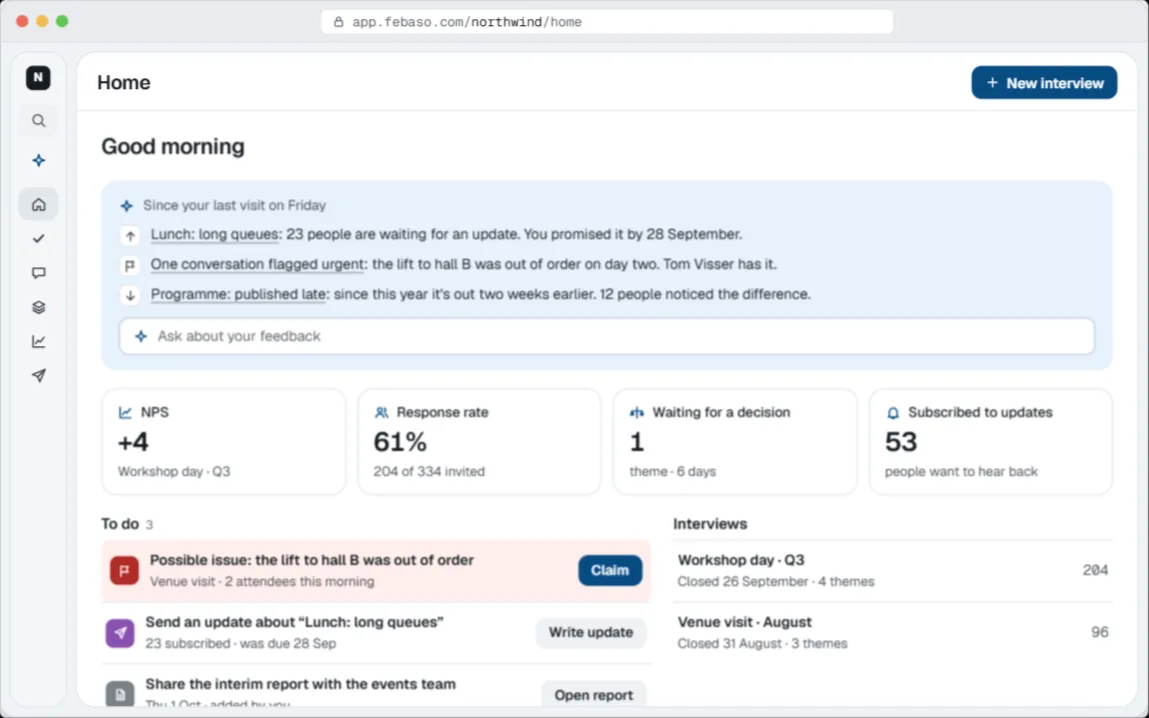
Febaso shows which themes haven't received anything back yet and how many people want an update about them.
02
You decide and write the update
A decision, or an explanation why not. Febaso helps you say it short and clear.
03
Whoever raised it gets a message
Only those who raised the theme and wanted to hear back, in their own language. Through Febaso, apart from the answers.
See it yourself
From answer to update, in ten taps.
Answer an interview, see the theme take shape and send the update. With made-up data, and then you look around yourself.
Ten taps, with made-up data. Then you look around yourself.
Now and next
Collecting feedback is half the work. Reporting back finishes it.
- From: Northwind
Sessions: the two busiest tracks run apart
At next year's Summit the two busiest tracks run apart, and the programme is out two weeks earlier. We'll tell you how it goes by mid-January.
How it often goes: People give feedback and never hear anything back.
With Febaso: Per theme a message to whoever raised it: this is what we decided.
- Themes513 answers · themes readySessions: too many overlap186Lunch: long queues142Networking: too little time97
How it often goes: Reporting back takes hours: working out who said what, and writing a mail per group.
With Febaso: Febaso keeps track of who wants a message per theme, and helps you write the update.
- Processing in the EU
- Anonymous when you choose
- Stored apart
- Only on request
How it often goes: You can't report back without knowing who it was, and with anonymous you don't want to know.
With Febaso: The update goes through Febaso, apart from the answers. You never see who gets it.
Wat kan er beter?
What could be better?
Was könnte besser sein?
Co można poprawić?
How it often goes: The update is in one language, for a group that speaks several.
With Febaso: Everyone gets the update in their own language.
- Sessions: too many overlap
↑ 11 pts since 2025
“Two talks I wanted ran at the same time. I had to choose, and I picked wrong.”
Needs a decision42 subscribedHow it often goes: The next survey starts with people thinking: it never leads to anything.
With Febaso: People see their feedback leads somewhere, and answer more honestly next time.
Northwind, Marieke and every answer here are made up for this demo.
Honest about where we are
We build this together with the first organisations.
Developed together
Reporting back is where Febaso is heading, and we work it out with the first organisations. So you can help decide how it looks.
You never see who they are
Whoever wants a message leaves a contact detail that Febaso stores separately. When you add a decision to a theme, the message goes through Febaso, not through you.
Only whoever wants it
Nobody gets a message without wanting one. Whoever doesn't want to hear back, doesn't.
A decision stays your decision
Febaso writes nothing without your approval. You decide what is said and when.
Where you use it
Anywhere people deserve something back.
Why this matters
Reporting back is the weak link.
For his graduation research, founder Bryan Bakker spoke with thirteen people who run evaluations and quality assurance in Dutch higher and vocational education. Almost everyone recognised this: the feedback comes in, but students rarely hear what happens with it.
“An evaluation of a module that takes place now can lead to a change in two years.”
Policy adviser, higher education (translated from Dutch)
Graduation research by Bryan Bakker (Creative Business, HvA), March to June 2026: thirteen interviews at twelve institutions, thematically analysed. Quote anonymised.
- find the feedback to students weak
- 11/13
Privacy and trust
Read how we handle privacyProcessing in the EU
And never used to train AI models.
Anonymous when you choose
You choose per interview whether answers are anonymous. Anonymous means you never see who said what.
Stored apart
The contact detail of whoever wants a message is kept separate from the answers.
Only on request
Nobody gets a message without wanting one.
Questions about reporting back
How do I tell people what happened without knowing who said what?
Whoever wants to stay informed leaves a contact detail that Febaso stores separately. When you add a decision to a theme, only the people who raised that theme get the message, in their own language. You never see who they are.
Is this available yet?
We are working out reporting back with the first organisations, and you can see it in the demo. In an intro I show where it stands now and what you can expect.
What if I can't change anything?
Then you say so: an update can explain why something doesn't change. People often value an honest answer more than silence.
Does Febaso send messages by itself?
No, not without your approval. You write or approve the update and choose when it goes.
Does everyone get a message?
Only whoever raised the theme and wanted to hear back. Whoever doesn't want to hear anything, doesn't.
In which language does the update arrive?
In the recipient's language. You write in yours.
Close the loop.
In a thirty-minute intro I show how reporting back works and we discuss how it would fit your situation.
- Per theme a decision and an update
- In the recipient's own language
- You never see who they are
Book an intro
Pick a momentRather write? Send us a message.